
Find People Along a La Puente Street
A whole-street search works best when each house number is handled as its own parcel. La Puente's city street booklet supplies the first check. It lists street names, number ranges, ZIP codes, odd or even sides, and the direction of the range. A postal La Puente label can cover county territory, so the booklet keeps a city request from going to the wrong office.
The street directory workflow then moves from address to owner clue to historical party. It does not claim that an owner is the only person at the address. A permit applicant, a tax-mail recipient, a directory subscriber, and a recorded grantee can all be different people.
- Check the number range and city or county jurisdiction in the La Puente Street Booklet.
- Enter each situs address in the Assessor portal. Note the AIN, parcel creation date, structure facts, and latest recording date or document number.
- Open the Assessor map and click side, rear, and opposite parcels so every AIN is recorded separately.
- Request owner information through an Assessor district office or Property Data Sales, then carry the owner name and year to the RR/CC grantor-grantee index.
- Overlay city permit records, the restricted voter-file channel, and historic GTE address books only for a lawful, specific research purpose.
Once the street has been narrowed to a person, the La Puente resident lookup workflow takes over. The street directory remains the place for the address chain.
Check La Puente Street Jurisdiction First
The city's street booklet is unusually precise. It can assign a number range to incorporated La Puente, unincorporated Los Angeles County, or only one side of a street. Aileron Avenue shows the patchwork: 600-739 is city on both sides, 894-924 is county, 740-999 returns to city, and 1001-1199 is city on the odd side only. Amar Road shifts from ZIP 91746 at 13700-14299 to ZIP 91744 at 14300-14598, with further side-specific ranges.
That detail affects every record request. City Building and Safety holds city permits. County Public Works or Regional Planning may hold the file for a county segment. A street name alone is not enough. Give the custodian the exact number, APN or AIN when known, and a date range.
La Puente has no authoritative citywide street-renumbering year in the research. If an old address does not match, compare the range, side, orientation, parcel creation date, subdivision lot and legal description rather than inventing a renumbering event.
Search the La Puente Assessor Portal
The Los Angeles County Assessor Portal offers “Search by AIN or Address,” Basic Search, Legal Search, and a Map Search mode. AIN means Assessor Identification Number. It is formatted as a four-digit map book, three-digit page, and three-digit parcel, often written as 4-3-3. The search box accepts address autocomplete or the ten-digit AIN.
| Search by AIN or Address | Autocomplete text; required for a direct parcel lookup. An AIN uses ten digits. |
|---|---|
| Basic Search | Principal address or AIN lookup. |
| Legal Search | Map or legal-property mode. It is not a recorder party search. |
| Map Search | Pan, zoom, and click parcels along a street or at a cross street. |
Parcel results can expose situs address, city and ZIP, land and improvement values, use code, design, year built or effective year, units, bedrooms, bathrooms, square footage, latest recording date and document number, roll year, and parcel creation date. The public web result does not display the owner or owner mailing address. Those fields are available at Assessor offices or through Property Data Sales.
Situs and Mailing Addresses Differ
Situs means the physical place where a parcel lies. Mailing address means where assessment or tax correspondence is sent. If the two match, owner occupancy is possible but not proved. If they differ, the mailing address may belong to a trust, agent, business, second property, or another tax contact. Neither field identifies every person at the site.
The Treasurer and Tax Collector can show a secured or unsecured bill, payment, or delinquency through Los Angeles County tax services. Tax data answers a bill question. It does not turn a parcel into a resident roll. A homestead or homeowner exemption, if displayed, may support an occupancy inference but remains only one clue.
- Parcel
- A mapped unit of land assigned an AIN for assessment and map work.
- Situs address
- The physical location tied to the parcel, not necessarily its tax-mail destination.
- Plat
- A recorded map that lays out lots, blocks, streets, and sometimes easements.
- Criss-cross directory
- A directory arranged by street and number so an address can lead to a listed subscriber.
These definitions keep a La Puente street directory from making an ownership clue sound like proof of household membership.
Browse Both Sides on the Parcel Map
The Los Angeles County Assessor Map Search is the practical street-browse tool. Zoom below the parcel layer's effective 1:10,000 display scale, click the target polygon, and record its AIN and situs. Then click the side and rear adjoining parcels and the lots across the road. The official service supports spatial and distance queries, but no consumer-facing radius or buffer button was verified.
Map geometry shows the parcel fabric and public property facts. It does not reveal online owner names. A continuous street can cross city limits, ZIP lines, or county responsibility, so map browsing should be paired with the street booklet before a permit or code request.
The official map help page explains the controls and the limits of the viewer.
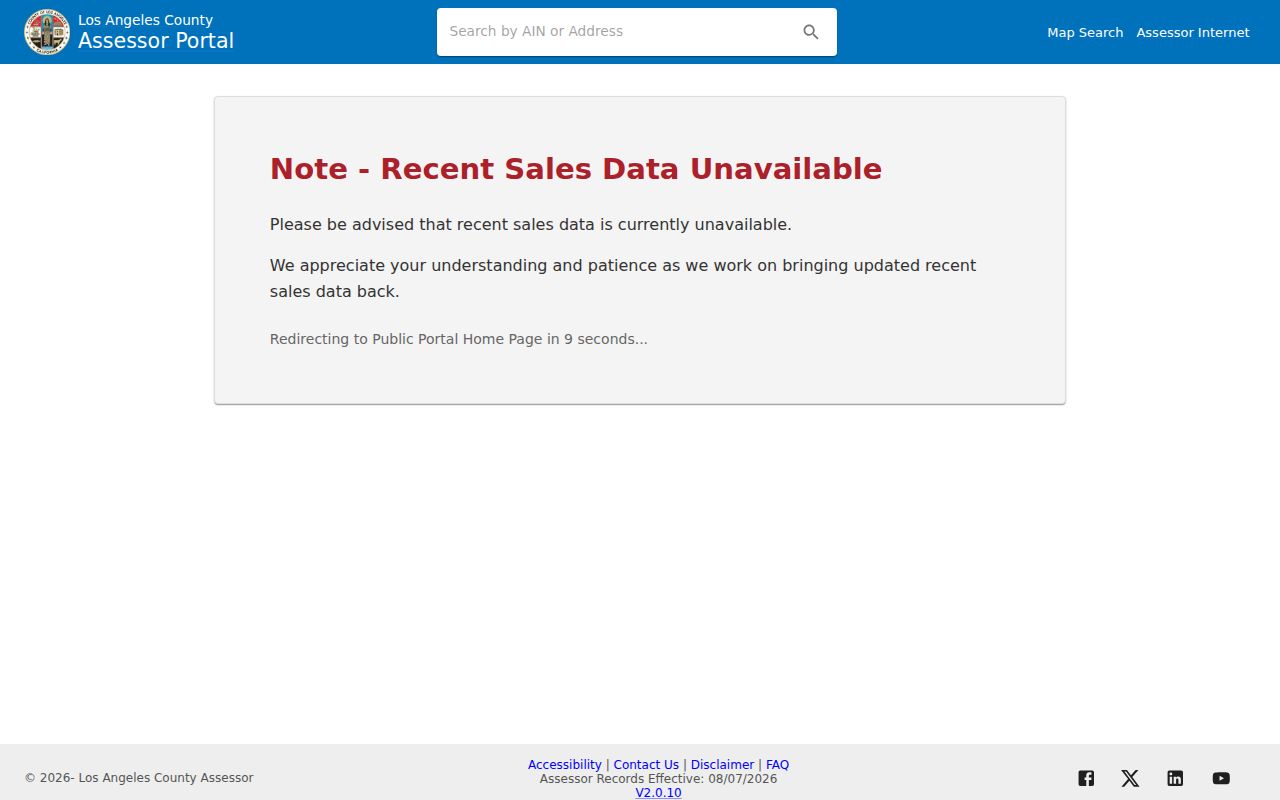
The parcel-viewer capture shows why a street can be walked parcel by parcel even when the public web result does not name the owner.
The Assessor map help page supplies the control details for interpreting the parcel layer.
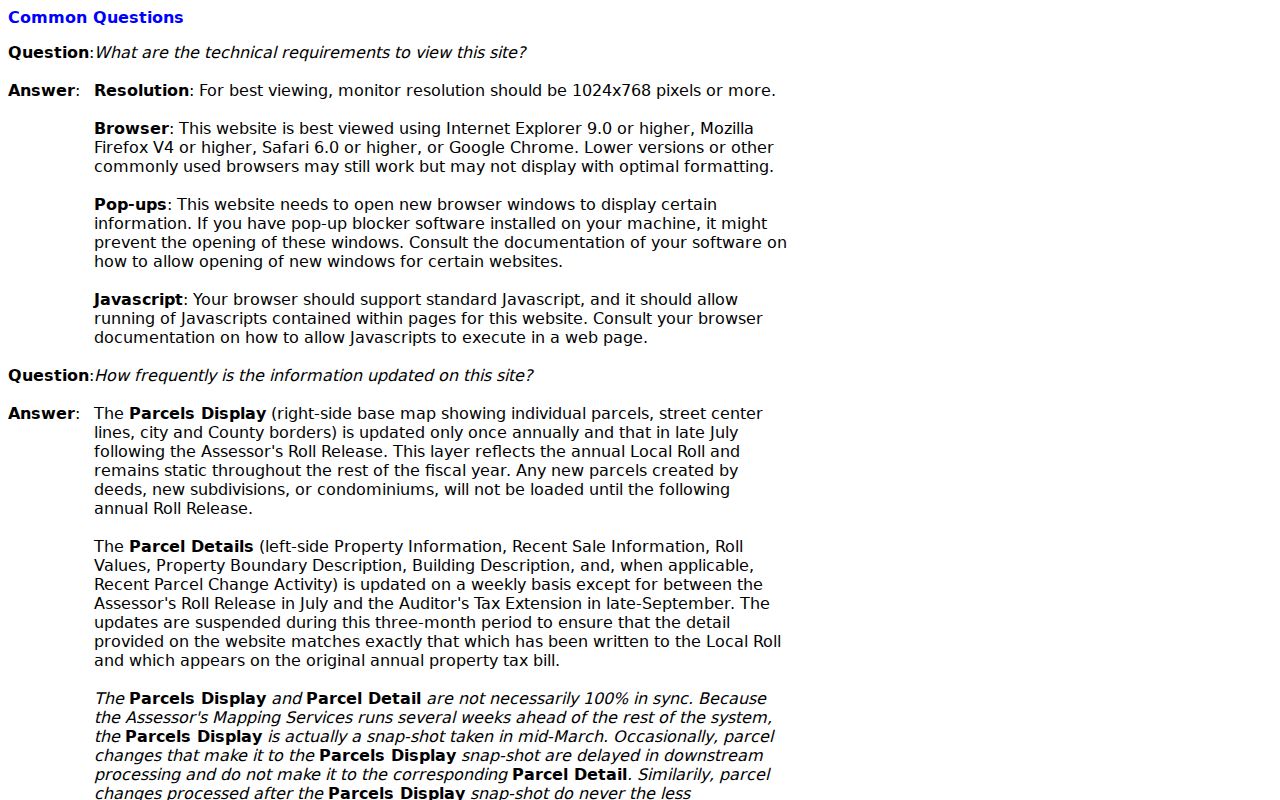
The help capture is useful when a map view and a legal parcel question do not line up at first glance.
La Puente Records Searchable by Address
Address-keyed records are useful, but each set has a different person clue and access channel. The table separates them before a street search begins.
| Record set | Street or address method | Person clue | Limit |
|---|---|---|---|
| Assessor | Address autocomplete or AIN | Parcel, situs, building facts, latest recording clue | Owner name and mailing address suppressed online |
| GIS map | Pan, click, spatial or distance query | Adjacent parcel fabric and situs components | Technical service; up to 1,000 records |
| City permit file | Monthly list or exact-address request | Applicant, contractor, work date, final notice | City jurisdiction and redactions apply |
| Recorder | Convert parcel to name and recording year | Grantors, grantees, prior parties | No address or APN search; index is office-only |
| GTE address books | Street and house number | Listed subscriber or business | 1988-93 regional holdings; omissions are common |
| Voter file | Permitted street or address extract | Registered-voter presence | California purpose and use limits |
Business directories and fictitious business name filings can add a commercial address, but a business location is not a home. Use the record set that matches the question and keep the source date beside the result.
Turn a La Puente Street into Deed Parties
The recorder's office cannot search a La Puente street directly. Once the Assessor office supplies the current owner, search that person or entity as grantee in the likely acquisition year. Read or order the purchase deed, take the grantor's name, and search that earlier party as grantee. Repeat until the chain reaches the period of interest.
The RR/CC index is alphabetical by grantor or grantee within a recording year. Records since 1851 are reviewed in Norwalk, with 1851-1957 on the lower level and 1958-present on the second floor. Free viewing is by appointment. Copies can be requested online, by mail, fax, or in person. If no document number is known, state the name, year, and document type. Telephone index searches are not performed.
Recorded instruments can contain a legal description, consideration or transfer-tax clues, signatures, return address, execution date, recording date, and document number. Images are not available on a public web index. The RR/CC access explanation is the correct starting link.
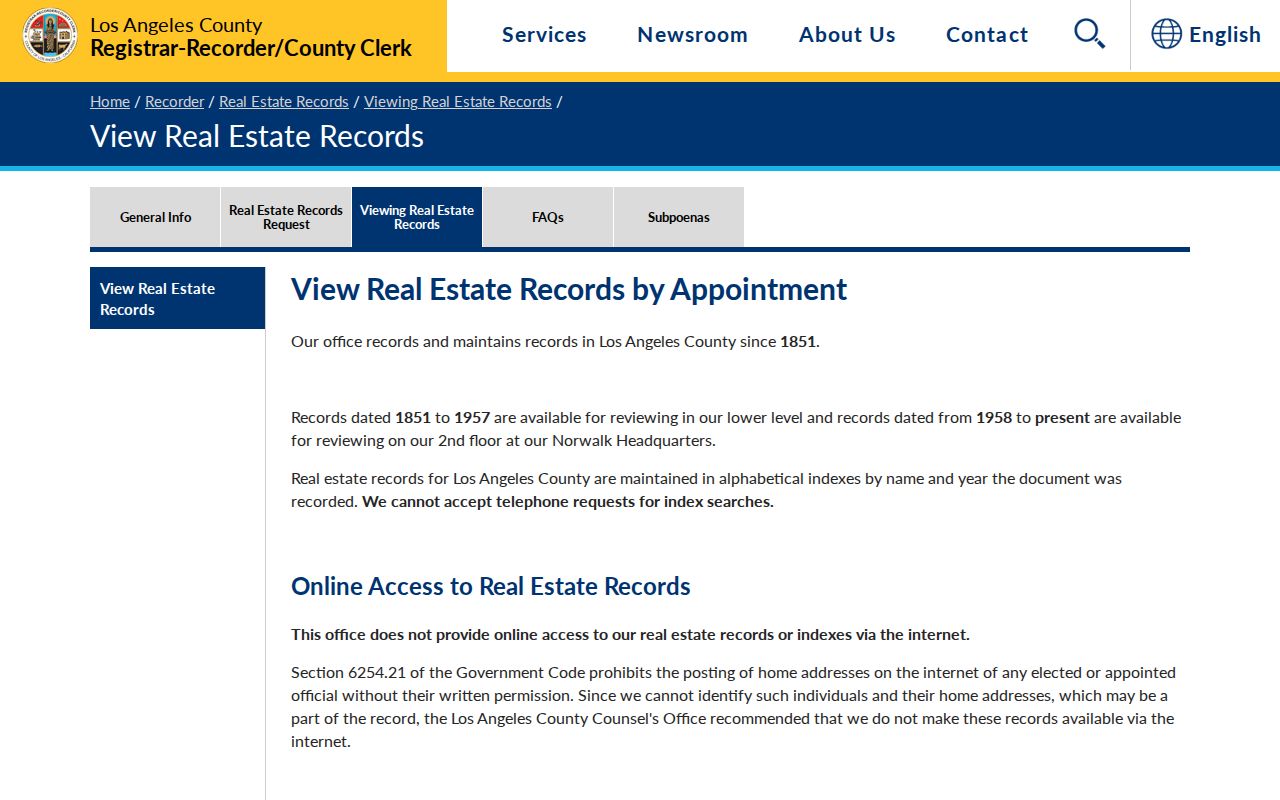
The recorder capture makes the key handoff visible: the street supplies a parcel, while the office index supplies a name and year.
Date Physical Change with Permits
La Puente Building and Safety links monthly building-permit activity and an inspection-request route. A property-specific file can connect an address to an applicant, architect, contractor, permit card, inspection history, and work date. An applicant is not necessarily the person who occupied the parcel, so permit evidence dates physical change rather than proving a household.
Use Building and Safety for city-held material and the city's NextRequest portal for an exact request. Include the street address, APN if known, permit number if known, the record types sought, and a date range. Plans may have copyright or security limits. Code cases can contain complaint-source or investigative information that is withheld, so ask for final notices, orders, and milestones when those are the real need.
If the booklet places the address in county territory, route the request to county Public Works or Regional Planning instead of assuming City Hall holds it.
Use La Puente Reverse Directories Carefully
Norwalk Californiana holds regional GTE address directories from September 1988, September 1989, March 1990, September 1992, and March 1993. A reverse or criss-cross section reorganizes names by street and number. Those books can place a listed subscriber at an address between census dates, but unlisted numbers, service changes, and publication gaps are normal.
The library's local-history gateway also highlights nineteenth-century newspapers and city directories. Request the exact catalog item and photograph or copy its abbreviation page before reading entries. A 1966 dedicated La Puente directory exists, while the later GTE books are regional. The historical collection itself is treated in the La Puente city directory collections.
Use reverse books as a dated occupant clue, then compare the name with a deed, census household, obituary, permit, or probate file. A directory listing is not a title record and silence is not proof that an address was empty.
What a La Puente Street Directory Cannot Show
No public source lists every person connected to a La Puente address. The web Assessor result omits owners. The recorder omits address searching. A deed identifies title parties, not every occupant. Utility, delivery, school, and customer lists are private. The DMV personal-information system is restricted, and protected Safe at Home participants may use substitute addresses.
California Elections Code section 2194 also prevents an ordinary street search from becoming a voter mailing list. A voter file requires an approved purpose, and signatures, Social Security numbers, and license identifiers remain confidential. A public parcel map gives structure, not a complete household.
Lawful use. Use street and address records for personal research, family history, property history, or civic understanding. Do not use a La Puente street directory to stalk, harass, intimidate, or harm anyone.