
Start a La Puente Resident Search
A name search and an address search take different paths. A parcel search can show an AIN, situs address, building facts, and a recent recording reference, but the public Los Angeles County Assessor portal does not display the owner name. A recorder search then works from the party name and year, not from the street. A court search can identify a case party, while a directory can show an occupant at a past point in time.
Use the first source that matches the question. For a current address clue, begin with the Assessor and map layers. For a deed trail, obtain the owner through the Assessor's office channel and carry that name to the Registrar-Recorder/County Clerk. For a past household, pair the library's city-directory holdings with the federal census. For a family event, use the proper vital-record copy class. The steps below keep those record types from being treated as one kind of proof.
- Write down the name, address, ZIP, date range, and the reason for the search. Record the source date for each clue.
- Check the Los Angeles County Assessor portal by AIN or address, then note the parcel facts and latest recording reference.
- Use the county voter-status tool only for personal registration checks, or request a permitted voter file under California law.
- Move to Los Angeles Superior Court, the County Clerk, or a vital-record custodian when the question concerns a case, filing, marriage, birth, or death.
- For older residents, ask LA County Library or Californiana staff for the exact directory year, abbreviation key, and shelf location.
When an online path ends, a narrowly worded request or an in-person index is the next step. The county CPRA form does not replace the special process for deeds, vital records, voter data, or court files.
La Puente Records Offices
Most La Puente resident records live at county level. The city keeps its own planning, permit, council, election, and administrative files. The Assessor maps parcels, the RR/CC holds recorded instruments and county vital records, and Los Angeles Superior Court keeps trial-court files. The division matters because no single counter can answer every question about a person or address.
City limits also matter. A postal La Puente address can fall in unincorporated Los Angeles County. Before requesting a permit, code, or planning file, compare the address with the city's street booklet and then send the request to the right custodian.
Los Angeles County RR/CC
12400 Imperial Highway
Norwalk, California
800-201-8999, option 3
Los Angeles County Assessor
County parcel and value records
Owner data by office or Property Data Sales
Public web owner names withheld
Los Angeles County Registrar of Voters
12400 Imperial Highway
Norwalk, California
800-815-2666, option 2
La Puente City Clerk
15900 E. Main Street
La Puente, CA 91744
626-855-1500
La Puente Assessor Address Search
The public Los Angeles County Assessor Portal starts with “Search by AIN or Address.” AIN means Assessor Identification Number. The portal offers Basic Search and Legal Search controls, while Map Search lets a reader pan, zoom, and click nearby parcels. It is a useful first stop for an address, but it is not a name-based La Puente residents directory.
The online parcel card can show the formatted AIN, situs city and ZIP, land and improvement values, use code, design, year or effective year built, units, bedrooms, bathrooms, square footage, latest recording date and document number, roll or base year, and parcel creation date. Owner name and owner mailing address are withheld online. Those fields require an Assessor district office or Property Data Sales.
| Search by AIN or Address | Required autocomplete text for a direct lookup; an AIN is ten digits and an address can be completed from suggestions. |
|---|---|
| Basic Search | Principal parcel lookup mode. |
| Legal Search | Map or legal-property mode; it does not create a deed-index search. |
| Map Search | Pan, zoom, and click parcels to browse a street and nearby cross streets. |
- Roll
- A recurring government record set, such as an assessment or voter roll, organized around a defined purpose.
- Index
- A finding aid that points to a record; an index line is not the same as the complete document.
- Criss-cross directory
- A street-and-number section that can lead from an address to a listed name.
- Parcel
- A mapped piece of land identified by an AIN for assessment and map work.
That split is central to a La Puente resident lookup. A parcel proves that land exists and can point to a recent recording. It does not list every person at the situs address. The Tax Collector can show a bill or delinquency, but tax status is not proof of residence.
La Puente Deeds Without an Online Index
Los Angeles County recorded property records are public in a broad sense, but the name index is not published on the open Internet. The RR/CC index is alphabetical by grantor, grantee, and recording year. Grantor means the person or entity transferring an interest. Grantee means the recipient. Neither address nor APN is a usable recorder search key.
Free viewing is by appointment at 12400 Imperial Highway in Norwalk. Records from 1851 through 1957 are reviewed on the lower level. Records from 1958 forward are on the second floor. Telephone index searches are refused. For a copy, give the document number when known. Otherwise provide the indexed name, recording year, and document title. The county describes a $0.50 per name per year real-property search, then $6 for the first copy page and $3 for each added page. Complete documents must be purchased.
Online copy orders use the county-linked vendor and may take up to 20 working days after receipt. Mail goes to RR/CC Real Estate Records Section, P.O. Box 1130, Norwalk, CA 90651-1130. The recorder also lists an email route for vital and real-estate questions. A deed trail is therefore a bridge from the Assessor's parcel facts to a recorded party, not a one-click resident list.
Practical handoff. Obtain the AIN and the current assessed owner through Assessor channels first. Carry the owner name and likely year to the RR/CC index, then follow each earlier grantor backward.
Current La Puente Resident Sources
Current sources answer different questions. The Assessor is parcel-centered. The voter tool is a personal status check. A court docket is case-centered. City files may name an applicant, contractor, or official party. None should be stretched into a complete list of households.
| Source | What It Can Show | Keeper | Access |
|---|---|---|---|
| Assessor parcel | AIN, situs, building facts, value, latest recording clue | Los Angeles County Assessor | Free address/AIN portal; owner at office or through Property Data Sales |
| Voter status or file | Personal registration status, or restricted voter-file fields | Registrar-Recorder/County Clerk | Self-check; file purchase requires a lawful purpose |
| Recorded instrument | Grantor, grantee, document type, recording year, document number | RR/CC Recorder | Norwalk index; copies by order |
| Court docket | Party role, case type, filing dates, register events | Los Angeles Superior Court | Case-type rules, courthouse terminals, and possible fees |
| City permit or request | Address, applicant, contractor, work date, final notice | La Puente or county custodian | Monthly activity or NextRequest; jurisdiction first |
| Directory or census | Dated occupant, spouse, occupation, address, household | LA County Library or NARA | Catalog, library database, physical volume, or public census |
When the goal is one person, use a workflow that matches dates, names, and record roles. When the goal is a whole street, the county parcel map and address chain belong on the La Puente street directory page.
La Puente Voter Records Have Limits
The Los Angeles County voter-status tool asks for last name, date of birth, house number, and five-digit ZIP Code. It is designed for a voter to verify personal registration, not for anonymous name and address browsing. A permitted voter file is a separate product. California Elections Code section 2194 limits its use to election, scholarly, journalistic, political, or governmental purposes, and the rules bar harassment, private solicitation, and unauthorized surveys.
A voter file may contain a name, residence and mailing address, party preference, status, registration date, precinct or district, and voting participation history. Participation only shows that a ballot was cast. It never reveals how someone voted. Driver-license and state-ID numbers, Social Security numbers, and signatures are confidential. Safe at Home and other protected records receive added shielding.
The county's published file page lists $146 for countywide information and $39 for an additional file. A requester must state a lawful purpose and accept use restrictions. Contact the Registrar of Voters at 12400 Imperial Highway, Norwalk, 800-815-2666 option 2, or voterinfo@rrcc.lacounty.gov.
See the official La Puente voter-status search before treating a registration clue as evidence.
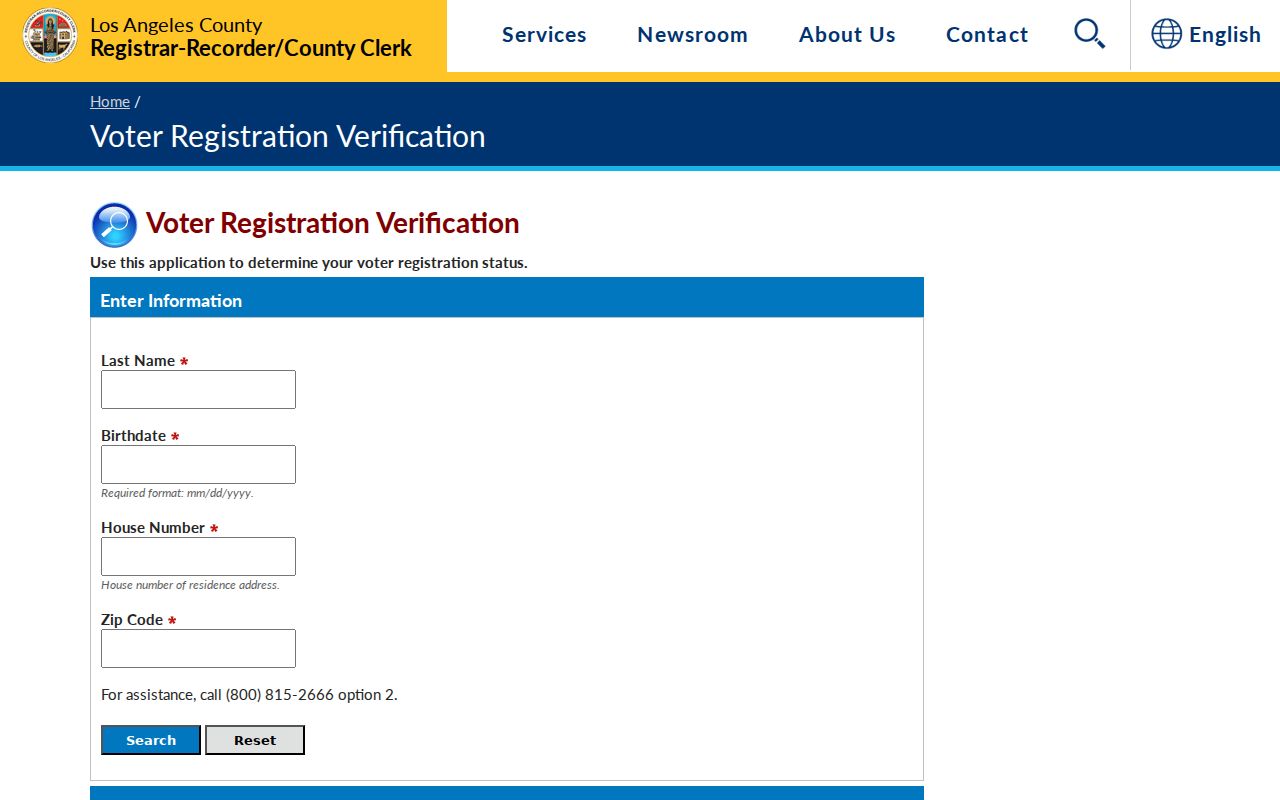
The captured county form illustrates the narrow purpose of this lookup: confirm a registration record for the person entering the details, rather than browse a public La Puente residents directory.
Los Angeles Court Records for La Puente
La Puente has no separate city court. Civil, family, probate, criminal, traffic, and small-claims cases are handled through the Superior Court of California, County of Los Angeles. The Los Angeles Superior Court Case Access gateway separates case types and access modes. California has no single statewide trial-court party search, so a county search is the key starting point.
Case-number mode uses a required case number. Name mode uses a party last name, with first name and date or year refinements varying by subsystem. Results can show a case title, party role, case number, filing court, case type, filing date, hearings, register-of-actions events, and a disposition where recorded. Remote access is narrower for criminal, family, civil-harassment, juvenile, adoption, sealed, and other sensitive files. Courthouse terminals can show more than an anonymous web session.
California court guidance commonly lists $0.50 per ordinary single-sided page, $40 for certification, and a $15 search fee when a clerk spends more than ten minutes locating a record. Confirm the current Los Angeles Court schedule. For federal cases, the Central District of California and PACER use a separate account and fee system.
A docket is the court's dated log of a case. It is not the whole file, and a party name is not proof that an allegation was true. Use case type, filing year, associated parties, and geography to separate namesakes.
California's official court-record access rules explain the difference between remote viewing and courthouse access.
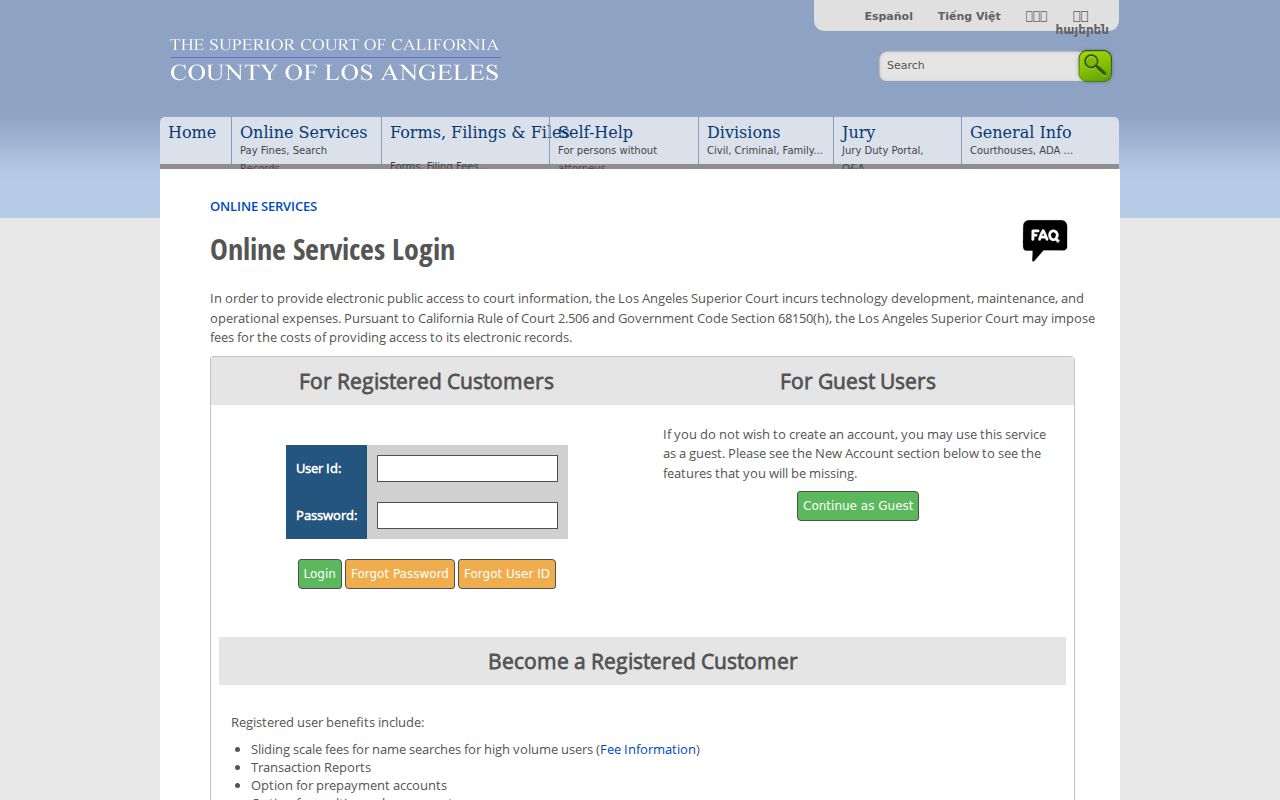
The court-access capture reinforces why a case index and a complete certified file should never be treated as the same record.
La Puente Vital Record Copies
For a birth, death, or marriage in Los Angeles County, the practical first custodian is the RR/CC. The statewide alternative is California Department of Public Health Vital Records. California separates certified authorized copies from certified informational copies. An authorized copy requires a statutory relationship or other approved basis and a sworn statement. An informational copy is marked so it cannot establish identity.
The county fee evidence lists $34 for a birth copy, $26 for a death copy, and $19 for a public or confidential marriage copy. Confidential marriage certificates normally require a court order unless a statutory route applies under Family Code section 511. Divorce case files belong to Superior Court, not the vital-record counter.
Applications ask for the record type, full name, event date and place, parents or both spouses where relevant, requester contact details, relationship category, purpose, signature, sworn statement, and payment. Mailed authorized-copy requests require the stated notarization or identification steps. Historical clues can also come from newspapers, church registers, cemetery offices, FamilySearch, and library databases, but an index clue is not an identity-grade certificate.
California access is not governed by a simple blanket rule that every birth opens after one number of years or every death after another. The copy class, eligibility, and collection determine access.
La Puente's Historical Directory Shelf
LA County Library's La Puente Valley Local History gateway highlights California census schedules from 1850 through 1910, Alta California from 1849 through 1891, the Los Angeles Star from 1851 through 1879, nineteenth-century newspapers, city directories, and official city and county histories. Exact shelf locations and year runs must be confirmed with reference staff.
Californiana's catalog confirms one dedicated La Puente directory from 1966. It also lists regional GTE address directories from September 1988, September 1989, March 1990, September 1992, and March 1993, followed by San Gabriel Valley East white and yellow page runs from 2000-01 through 2002-03. The historical trail is fragmented, not an annual Polk series.
The library branch began in a local schoolhouse in September 1913. Ask staff for call numbers, the volume's abbreviation key, and whether a requested item is at the branch, in Norwalk Californiana, or behind a licensed database. A city directory can show a listed occupant, spouse, occupation, and address on a date, while deeds answer title questions. The full collection treatment appears in the La Puente city directory collections.
Protected Addresses in La Puente
Some missing address clues are deliberate privacy protections. California's Safe at Home program gives eligible survivors and qualifying reproductive-health, public-entity, and household participants a substitute mailing address, mail forwarding, a service-of-process agent, and confidential voter registration. A substitute address does not prove that someone moved away.
California privacy law also limits DMV personal information. Recorded documents cannot simply be erased by request. Correction or redaction needs a statute, a recorder process, or court authority. The California Consumer Privacy Act and its amendments give covered business consumers rights to know, delete, correct, and opt out of sale or sharing, but those rights do not erase a government source record.
Read the California Attorney General privacy guidance for business-data rights and keep them separate from county record access.
The state privacy explanation is useful when a business-data opt-out is confused with a request to remove a lawfully retained government record.
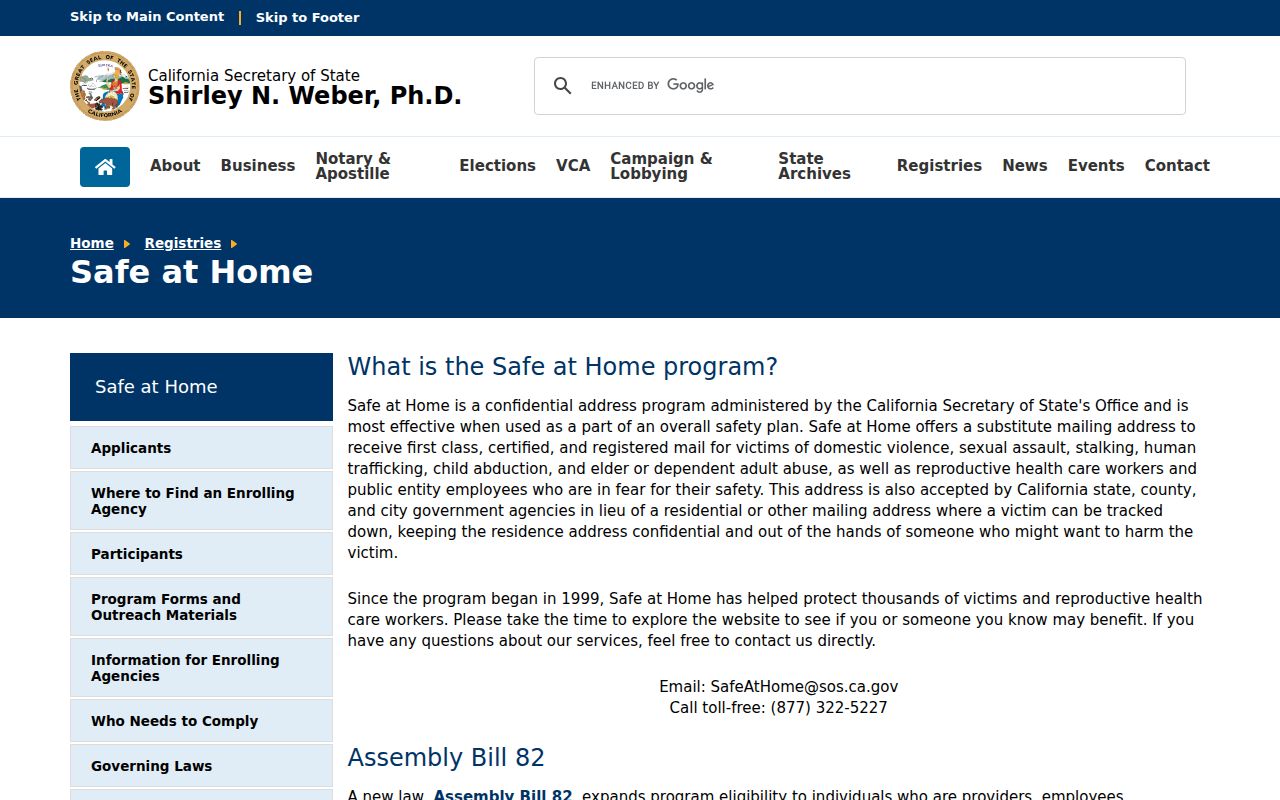
The state program image shows why a lawful directory search may end with a protected or substitute address rather than a blank to fill by guesswork.
The California Attorney General privacy guidance capture shows the separate path for covered business information and public source records.
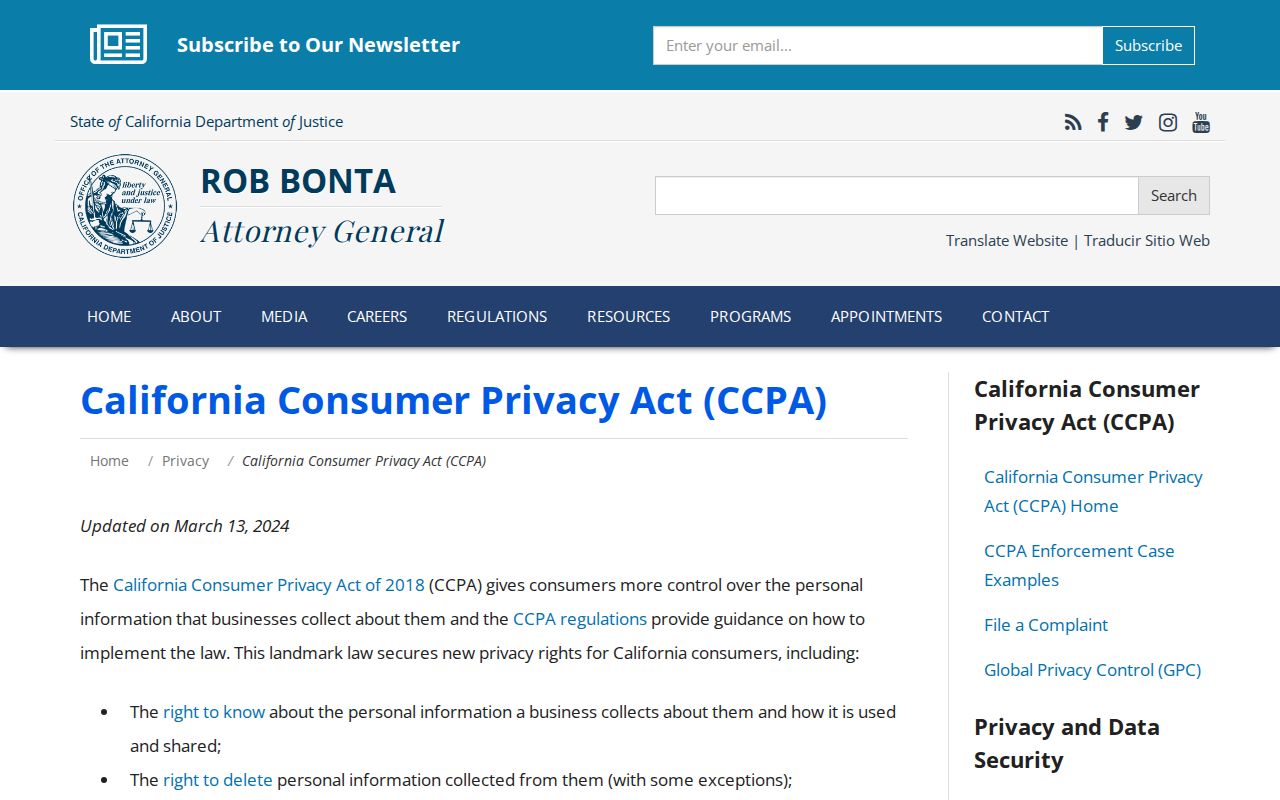
The privacy capture shows the separate path for covered business information and public source records.
La Puente City Requests by Address
The La Puente NextRequest portal accepts requests for existing city records. Give the property address, a date range, and the record type. The city states that it will make a determination within ten days, with an unusual-circumstance extension and an estimated availability date. That is a determination window, not a promise that every file will be produced within ten days.
Use the city channel for council minutes, ordinances, resolutions, contracts, election filings, permit activity, inspection material, and final code notices that the city holds. Building and Safety records should be checked against city limits first. A postal La Puente address may instead belong to county Public Works or Regional Planning. Ask for an existing permit card, inspection history, or final order rather than requesting a new report or an entire investigative file.
For a general county request, the RR/CC CPRA form explains department routing. Deeds, vital records, voter data, and court files follow their special channels rather than a generic request.
A request portal is most useful when the address, dates, and record category are narrow enough for the custodian to locate an existing file.
The La Puente public-records request guidance capture explains why a request should identify the property and the record type before it is submitted.
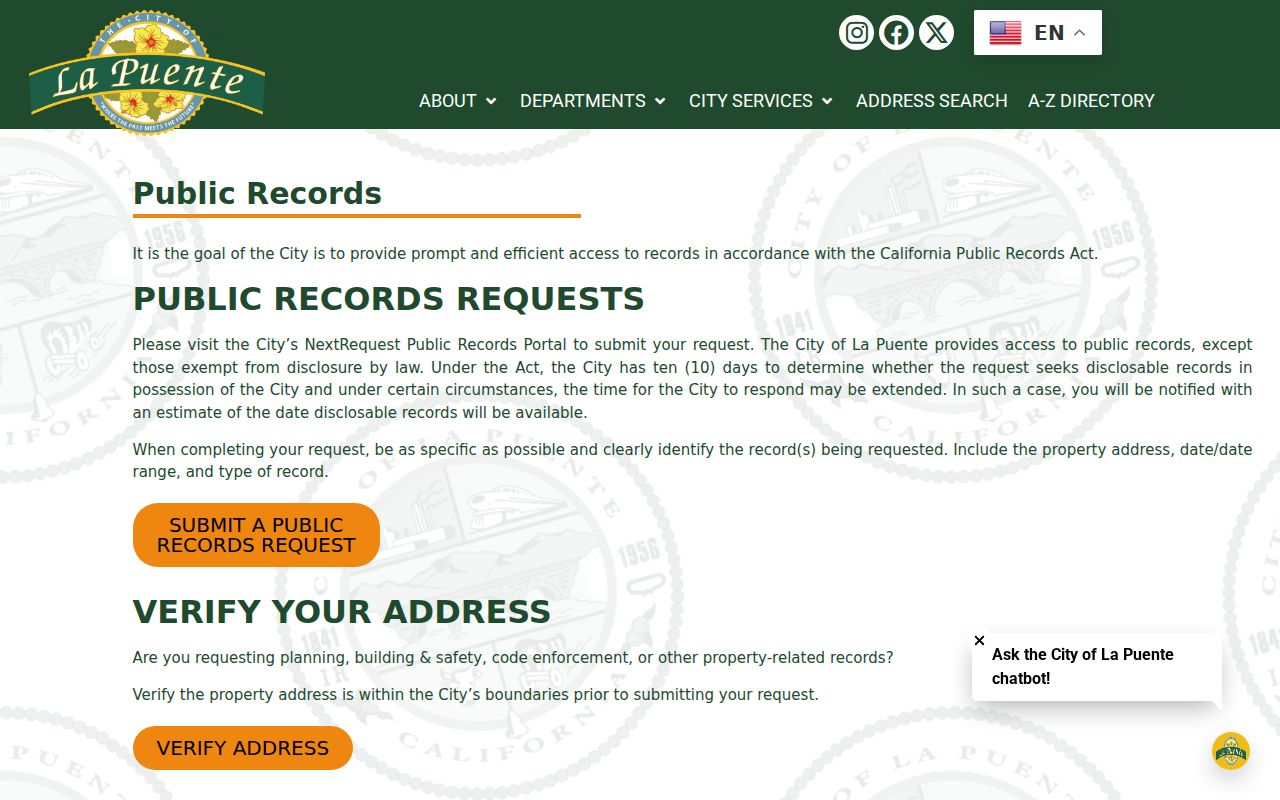
The guidance capture reinforces the difference between a city-held file and a county record that must be requested from another custodian.
Matching a La Puente Name to Records
A strong La Puente residents directory match uses at least two independent, dated sources. Normalize hyphens, spaces, accents, compound surnames, initials, and middle names. Compare spouse or associated party, occupation, parcel, filing date, and geography where those details are lawfully visible. A matching name alone is weak, especially in a county with many common surnames.
Probate can identify a decedent, petitioner, executor, administrator, heir, or devisee in a filed document, though an address may be old, sealed, or redacted. A business owner trail can join a city license, county fictitious business name filing, and California Secretary of State entity record. A professional clue can be checked with the Department of Consumer Affairs license search. An agent for service is a contact, not a residence.
Corrections belong with the custodian. Assessor errors go to the Assessor. Recorder index or image problems go to RR/CC. Voter corrections go to elections. Court docket issues follow court procedure. Business and license changes go to the responsible agency. A reference page should show the source and date rather than silently combine conflicting records.
| Source type | Strength | Limit |
|---|---|---|
| Official custodian record | Named keeper, defined record role, source date | Access rules, redactions, and coverage gaps remain |
| Commercial compilation | May combine several public clues in one interface | Namesakes, stale addresses, and unclear provenance can be mixed together |
Two-source rule. Use public records for family history, civic transparency, property curiosity, or reconnecting with consent. Do not use a name and address trail to stalk, harass, intimidate, or harm anyone.
La Puente Household Numbers and Ownership
La Puente's 2020-24 Census profile reports 9,624 households, 3.85 people per household, and 60.4 percent owner occupancy. The figure is useful context, not a resident roll. One assessed owner can represent only one title position while a household has several people, and a title holder may not live at the parcel.
The same profile reports a 2025 population estimate of 36,423, down from 38,062 in 2020 and 39,816 in 2010. Large households make the distinction between a parcel record and a resident directory especially important. Use those numbers to understand why no single public source can stand for every person in La Puente.
The parcel map is free online, while owner and mailing fields require an office or data channel. That contrast is one of the most important practical facts in a La Puente residents directory search.
La Puente's History in Resident Records
Modern records become clearer when the place name is read across time. Rancho La Puente received a preliminary grant in 1842 and finalization in 1845. Puente town developers acquired land in 1885 and laid out the town in 1886. La Puente incorporated on August 1, 1956. Earlier names and county custodians can therefore matter more than the modern city label.
Town fires were documented in 1897 and 1923, but the research does not say that county deeds, court files, or vital registers were destroyed. The safe approach is to verify each gap against the custodian, library catalog, and archive rather than turn a local story into an unsupported records-loss claim. The RR/CC review of recorded documents from 1850 onward and the county archive program commissioned in 2012 add useful preservation context.
La Puente's directory story follows the same pattern: one dedicated 1966 volume, regional GTE books in 1988-93, and regional white and yellow pages into 2005. A local historical society adds Rowland Home and local-history archives, with public showings described in the research. Use the dates and place names as search anchors, then confirm the record itself.
The final result is a residents directory built from distinct evidence: parcel facts, recorded parties, civic status, court events, vital copies, and historical listings. Each source has a keeper, a date, and a limit.